Resplendent Quetzal: Guatemala's emblematic bird
With its sublime colors and shimmering plumage, the Resplendent Quetzal is renowned as one of the world's most beautiful birds.
With its sublime colors and shimmering plumage, the Resplendent Quetzal is renowned as one of the world's most beautiful birds. Found exclusively in Central America, it is the national symbol of Guatemala. A portrait of this sublime creature that was, for a long time, revered by pre-Columbian civilizations.
The Resplendent Quetzal at a glance
Appearance
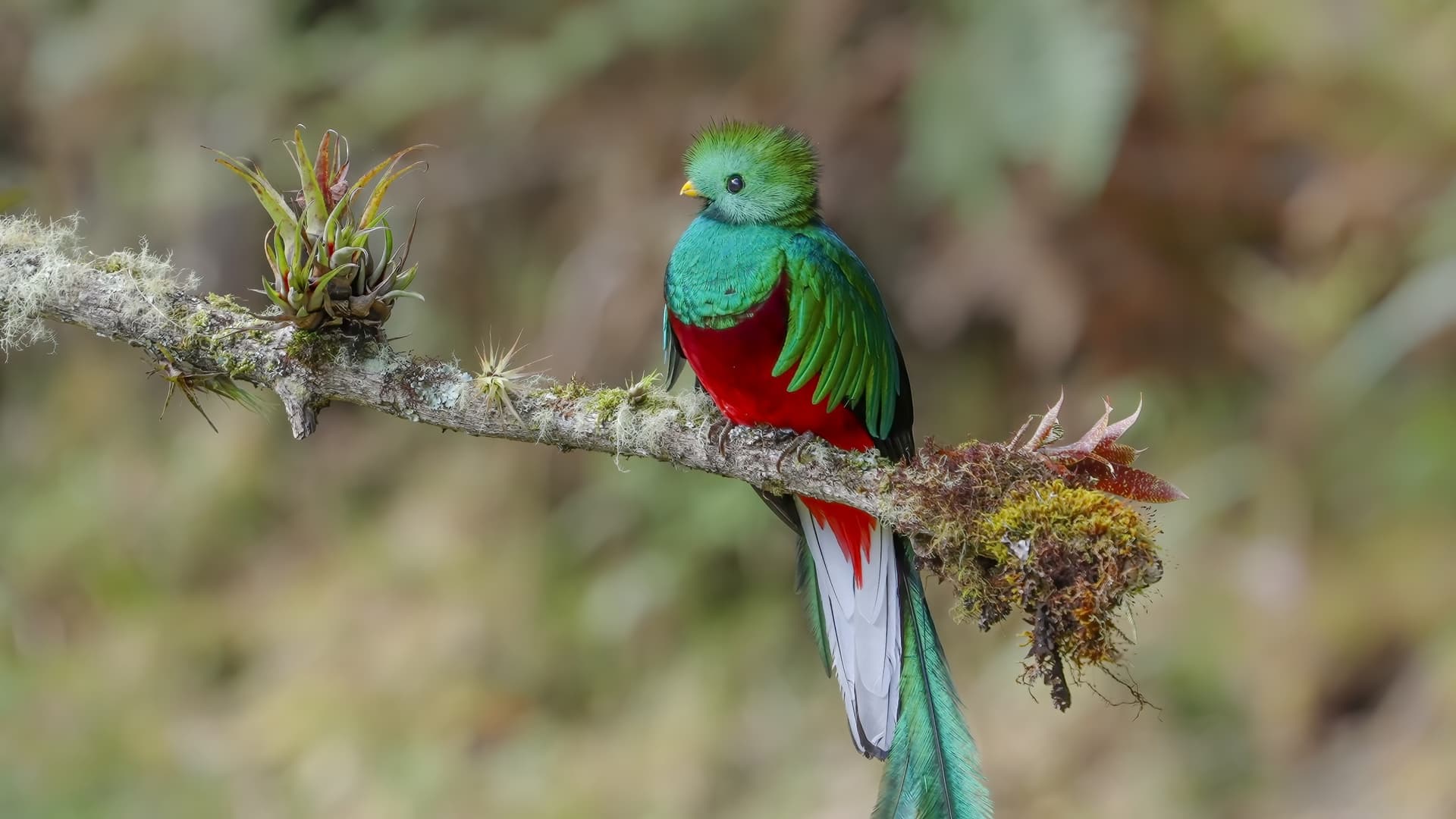
The Resplendent Quetzal (Pharomachrus mocinno in scientific nomenclature) belongs to the Trogonidae family. It measures less than 40 cm in height but appears larger due to the elongated feathers that form its tail (approximately 60 cm).
Renowned as one of the world's most beautiful birds, the Resplendent Quetzal features plumage that can change colors (an iridescence phenomenon). Its upper parts and throat are adorned with blue-green-iridescent plumage. On the lower parts, particularly the lower abdomen, its plumage is crimson red.
In males, one can observe coppery and golden reflections depending on the light. The female wears identical coloration but lacks the brilliant reflections. Furthermore, she does not possess as long a tail and lacks a crest.
Origin
Two subspecies of the Resplendent Quetzal exist:
Pharomachrus mocinno mocinno, found in southern Mexico, Guatemala, Honduras, eastern El Salvador, and north-central Nicaragua;
Pharomachrus mocinno costariensis, found primarily in Costa Rica and the highlands of western Panama. This subspecies is slightly smaller.
Habitat

As we have just seen, the Resplendent Quetzal subspecies live exclusively in Central America. They are found primarily in the canopy and sub-canopy of evergreen humid forests. It is a highland bird encountered between 900 and 3,200 meters in altitude.
Diet
The Resplendent Quetzal is primarily a frugivorous bird: it feeds on fruits from plants of the Lauraceae family. However, it also occasionally follows a carnivorous diet by consuming small animals, particularly insects (beetles and their larvae, flies, orthopterans, moths) as well as small frogs, lizards, and snails. It should be noted that chicks are insectivorous during their first 10 days of life.
Behavior
The Resplendent Quetzal is a territorial and monogamous bird. Indeed, after displaying (often in groups of about ten individuals), the male forms a pair with a female with whom he will build a nest in a tree cavity. Throughout the nesting period, he defends his territory with calls and whistles.
The female typically lays two eggs, and incubation lasts an average of 17 to 19 days. The chicks remain in the nest for 3 weeks before taking flight. At the end of the nesting period, the bird loses its feathers which will grow back the following year. It can no longer fly and becomes vulnerable to the sun and parasites, making it more susceptible to predation.
Why is the Resplendent Quetzal Guatemala's national symbol?

The Resplendent Quetzal (from the Aztec word quetzalli, meaning "precious" or "magnificent plumage") stands at the heart of Mesoamerican mythology and certain Central American legends. Revered by pre-Columbian civilizations, it was considered by the Maya and Aztec peoples as a symbol of goodness, light, freedom, and much more.
Its feathers were used by the most powerful figures. Consider, for example, the Aztec emperor Moctezuma, who possessed an impressive headdress of one meter fifty composed of Quetzal feathers. The feathers also appear in one of the principal Aztec deities, the famous "feathered serpent." In any case, it was forbidden to kill a Quetzal, and this act resulted in the death penalty.
Today, the Resplendent Quetzal is Guatemala's emblematic animal. It has even lent its name to the country's official currency.
Where to see the Resplendent Quetzal in Guatemala?
Would you like to improve your chances of spotting the Resplendent Quetzal on a journey through Guatemala? Head to the region of Las Verapaces, in the forests of Alta Verapaz and at the Biotopo del Quetzal where you may glimpse them.
Located northwest of Salamá and southeast of Cobán, el Biotopo del Quetzal is a nature reserve of 1,017 hectares created in 1976 with the objective of protecting the Quetzal and its habitat, the cloud forest. It is a humid subtropical forest situated between 1,500 and 3,000 meters in altitude where you will find more than 87 bird species, 58 animal species, and 50 tree species. Several hiking trails allow you to explore the area.
Good to know: the best period to hope to see the Resplendent Quetzal is between March and June.
A protected species of near-threatened status

According to the latest estimates, fewer than 50,000 individuals of the species remain in their natural environment. Several factors explain the decline in its population over recent decades:
Deforestation (thinning and destruction of forests),
Trapping for illegal trade,
Poaching for its feathers.
Faced with this reality, the International Union for the Conservation of Nature (IUCN) has classified the Resplendent Quetzal in the category of near-threatened species. Furthermore, numerous national parks have been established throughout Central America to protect the species.
Guidelines for observing Quetzals without disturbing them
For all the reasons mentioned above, it is advisable to follow responsible conduct guidelines should you have the opportunity to see Quetzals during a trip to Guatemala. Just as with all wild animals you may encounter, here are some rules to respect:
Be as quiet and discreet as possible
Maintain a safe distance to avoid frightening them and prevent disease transmission.
Never attempt to touch or approach them (remember they are wild animals prized by poachers for illegal trade and should not become accustomed to human presence).
Never try to feed them, as this would disrupt their natural diet and disturb ecosystem balance.
Finally, if you opt for a guided trek to encounter these birds and other wildlife, always ensure you choose a conscientious local guide who respects the environment. Do you need a guide? Consider reaching out to us!
Frequently asked questions
The best period to observe the Resplendent Quetzal in Guatemala is between March and June, corresponding to the bird's breeding season. It is during this time that males are most active and visible, particularly at the Biotopo del Quetzal in Alta Verapaz.
The best place to attempt spotting the Resplendent Quetzal in Guatemala is the Biotopo del Quetzal, a nature reserve of 1,017 hectares located between Salamá and Cobán, in the Las Verapaces region. This humid subtropical cloud forest, between 1,500 and 3,000 meters in altitude, is the species' primary protected habitat in the country.
The Resplendent Quetzal is deeply rooted in Mesoamerican culture. Revered by the Maya and Aztec peoples as a symbol of freedom, light, and goodness, it was so precious that killing one was punishable by death. Today, it is Guatemala's emblematic animal and has lent its name to the national currency, the quetzal.
The Resplendent Quetzal is classified as 'near threatened' by the International Union for the Conservation of Nature (IUCN). Its population is estimated at fewer than 50,000 individuals in the wild. The primary threats are deforestation, poaching for its feathers, and trapping for illegal trade. National parks and reserves have been established throughout Central America to protect the species.
The Resplendent Quetzal is primarily frugivorous: it feeds on fruits from plants of the Lauraceae family. It may also have a carnivorous diet and consume insects (beetles, flies, orthopterans), as well as small frogs, lizards, and snails. Young Quetzals are insectivorous during their first 10 days of life.