Multiethnicity and Cultural Diversity
Beyond its stunning landscapes, Guatemala offers a remarkable and enriching ethnic and cultural diversity. Two main cultures and societies compose the country. On one hand, the Mayans make up 60% of the population but own only around 20% of the land. Mostly artisans and farmers, they live primarily in the highlands and sustain the country's population through their crops grown mainly on the Altiplano...
Beyond its stunning landscapes, Guatemala offers a remarkable and enriching ethnic and cultural diversity. Two main cultures and societies compose the country. On one hand, the Mayans constitute 60% of the population yet own only around 20% of the land. These communities, primarily artisans and farmers, live mainly in the sparsely fertile highlands and sustain the nation through agricultural cultivation, especially market gardening on the Altiplano (on small plots of land). On the other hand, the Ladinos (non-indigenous peoples: mestizos, whites, and descendants of Spanish colonists) dwell predominantly in urban centers and control the majority of the country's wealth (land, employment, commerce, and more). Diverse worlds thus coexist within Guatemala.
Guatemala stands as the sole Mayan nation with an indigenous majority among its inhabitants. 21 ethnic groups compose the Guatemalan Amerindian community. The most represented Mayan ethnicities include the K'iche' (northwestern department), the Kaqchikel (around Sololá), the Mam (in the Sierra de los Cuchumatanes), and the Q'eqchi' (in the Cobán region). On the Caribbean coast of Central America, an Afro-Caribbean population with entirely distinct customs and cultures is present. These are the Garinagu, descendants of enslaved Africans brought from West Africa during the colonial period.
Guatemala is home to 23 different languages! 21 Mayan languages, Garinagu, and Spanish, the country's official language.
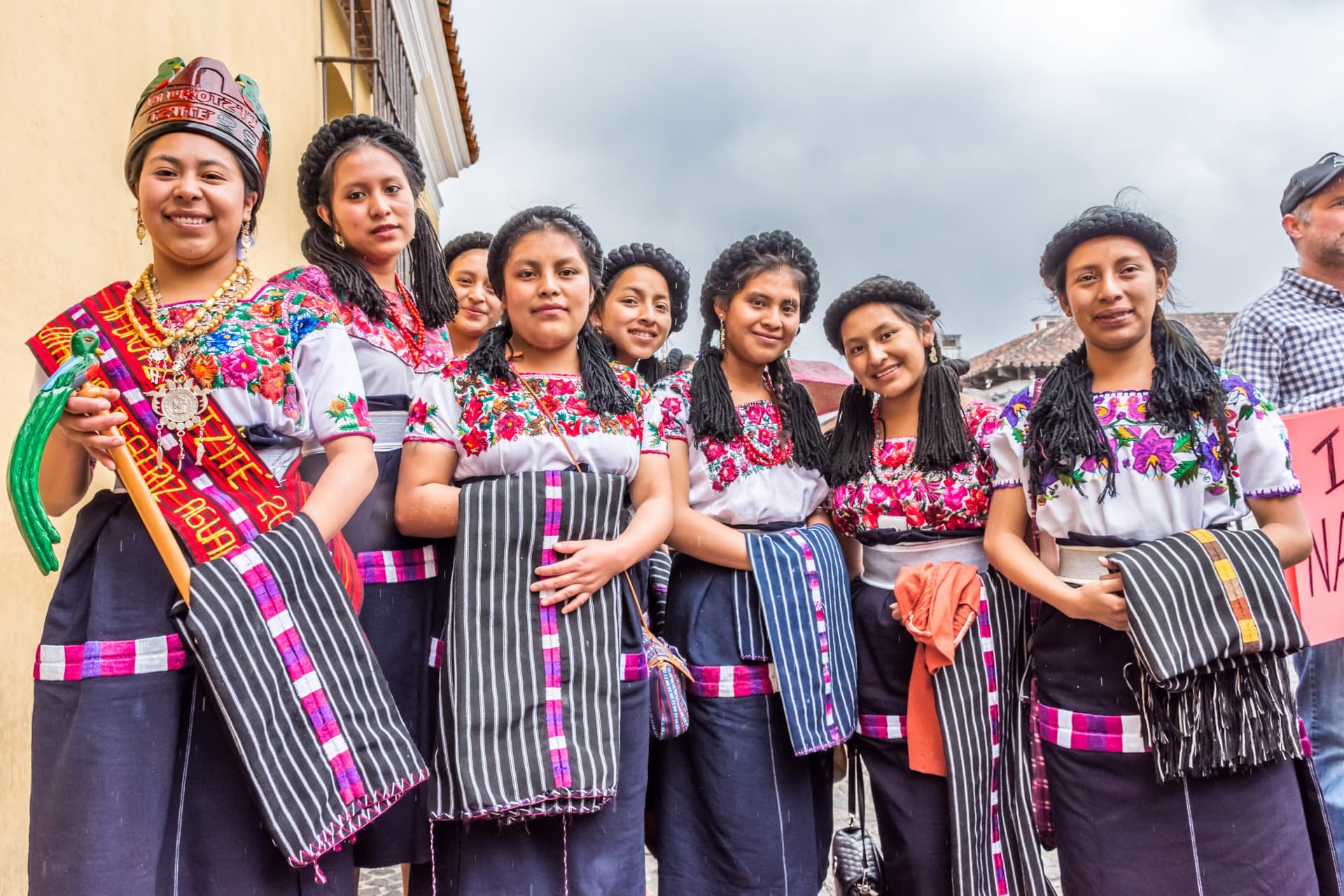
Although younger generations are gradually losing touch with traditional practices, traditional clothing is still predominantly worn by Mayan communities. Each village possesses its own distinctive dress, and visitors are captivated by the brilliantly colored hand-woven garments worn by many women and the traditional headdresses they display.