Petén and Tikal
A forested plain in northern Guatemala where the great classical Maya cities, Tikal foremost among them, rise from a canopy inhabited by howler monkeys and toucans.
Petén occupies the northern third of Guatemala, a vast limestone plain blanketed in humid tropical forest that extends into Mexico toward Chiapas and Belize. It was here, between the 3rd and 9th centuries, that classical Maya civilization reached its highest urban density before a collapse still debated by archaeologists. Today the region remains sparsely populated by national standards, organized around Flores, a small town perched on an island in Lake Petén Itzá and connected by a causeway to Santa Elena, where the regional Mundo Maya airport is located.
Climate shapes everything. We are in a tropical lowland zone, between 100 and 200 meters elevation, with temperatures of 28 to 32°C nearly year-round and high humidity. The dry season from February to May gives way to scorching afternoons. Rains arrive in June and last until October, often as brief but intense downpours that render certain forest trails impassable. This moisture explains the dense canopy where howler monkeys, spider monkeys, toucans, Petén ocellots live, and more discreetly, jaguars and tapirs.
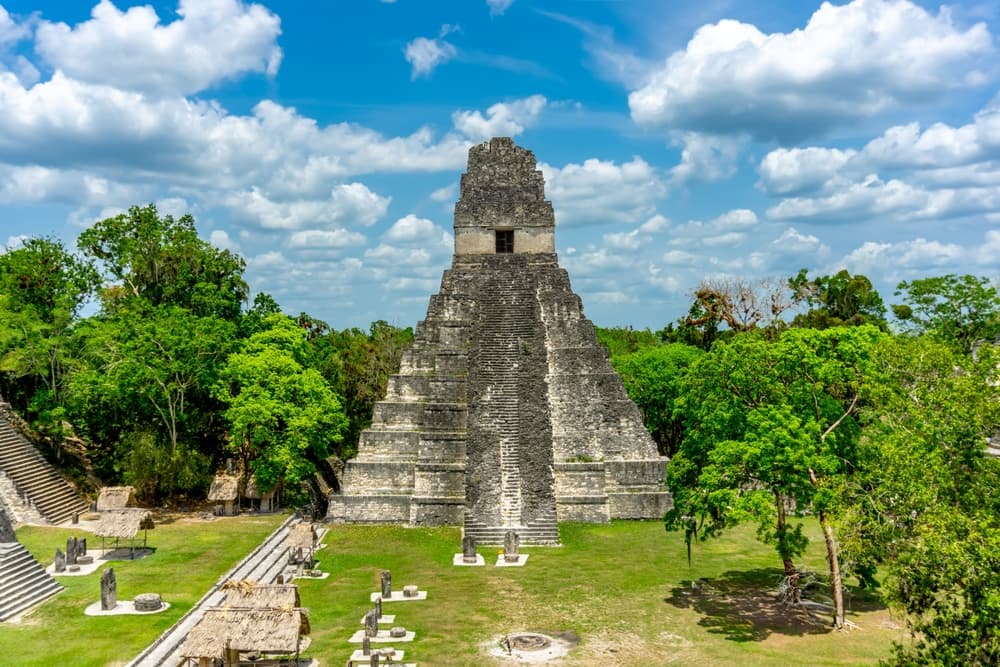
Tikal is the flagship site. Five great pyramids, including Temple IV reaching 65 meters, rise above the forest across a protected area of over 500 km². It is reached in an hour's drive from Flores. The site is best visited early in the morning, at opening at 6am, to enjoy relative coolness, the cries of awakening howler monkeys, and still-sparse crowds. A specific option, sunrise from Temple IV, requires authorization and entry around 4:30am with an approved guide.
Beyond Tikal, Petén concentrates several other major Maya cities that we include depending on the length of stay. Yaxhá, two hours to the east, overlooks a lagoon and offers a viewpoint from pyramid 216 at day's end, with far fewer visitors than Tikal. Uaxactún, 23 km north of Tikal on an earth road, houses an astronomical observation complex and a forest village still living from chicle and xate harvests. Further west, El Ceibal is reached by boat on the Rio La Pasión from Sayaxché, an approach that completely changes the site's perception.
For seasoned hikers, El Mirador remains the most demanding objective. This preclassic city, abandoned around 150 AD, harbors the pyramid of La Danta, one of the most voluminous in the Maya world. It is reached by five days of trekking round-trip from the village of Carmelita, through dense jungle, with mules for portage and camping under canvas. A cable car access project is regularly mentioned, but to date the route remains on foot, and that is what makes it compelling.
As for dining and local life, Petén has its own identity. You eat white fish from Lake Petén Itzá grilled, caldo de mariscos on the nearby Río Dulce coast, and red tamal wrapped in banana leaves. Flores, despite its modest size, concentrates charming lodging in colonial houses repainted in yellow, blue and pink, around the cathedral and the malecón where one watches the sunset over the lake.
To discover
Tikal at sunrise. Entry at 4:30am with a guide to reach Temple IV before dawn, listen to the awakening of howler monkeys and watch the mist rise over the temple peaks that breach the canopy.
Yaxhá at sunset. Climb pyramid 216 late in the day for a view over the Yaxhá and Sacnab lagoons, with far fewer visitors compared to Tikal.
El Mirador trek. Five days round-trip from Carmelita through the northern forest, camping under canvas, mules for portage and arrival at the foot of La Danta, a preclassic pyramid over 70 meters in volume.
Flores and Lake Petén Itzá. Island connected by causeway to Santa Elena, cobbled streets, late-afternoon swimming from wooden docks and launch crossing to the village of San Miguel on the north shore.
Uaxactún and the living forest. Forest village 23 km north of Tikal, accessible by earth road, where inhabitants still harvest chicle, xate and chili pepper, with a modest archaeological site but equipped with an astronomical complex.
When to go
The best season for Petén spans November to April. From November to January, temperatures peak around 28°C with cooler nights, and vegetation remains dense after the rains. From February to April, it is drier but also hotter, reaching 34°C in April, with the forest turning slightly golden and water sources concentrating wildlife, which facilitates observation.
From June to October, the rainy season brings daily showers, often late afternoon, with significant rainfall in September and October. Tikal remains visitable, the forest spectacular in its greenery, but trails to Uaxactún or El Mirador become difficult or closed. The months of May and November are interesting shoulder seasons, with fewer crowds and still-manageable weather.
Practical advice
We recommend two to three nights on site for a coherent stay: a full day at Tikal, ideally with sunrise entry, a half-day at Yaxhá late afternoon, and a free morning at Flores or boating on the lake. For El Mirador, allow seven additional days including preparation and recovery. Access is by direct flight from Guatemala City to Mundo Maya (Flores) in one hour, or by overnight road (8 to 10 hours) from the capital.
Petén logically combines with the Caribbean coast and the Rio Dulce, reached by road in five hours to the southeast, for a sequence of nature and Maya culture. Another coherent arrangement goes through the Verapaces and Semuc Champey heading back toward the country's center. Comfort in Flores and around the lake ranges from ecological jungle lodges to colonial guesthouses, with a few upscale options at La Lancha or Las Lagunas. The region suits families with children from 8-10 years old, archaeology and ornithology enthusiasts, and hikers for longer routes toward El Mirador or Nakum.