Las Verapaces
Nature lovers and jungle trekking enthusiasts flock each year to the Las Verapaces region in central Guatemala. Surrounded by several mountain ranges, this vast territory overflows with natural reserves and incredible ecotourism sites.
Nature lovers and jungle trekking enthusiasts flock each year to the Las Verapaces region in central Guatemala. Surrounded by several mountain ranges, this vast territory overflows with natural reserves and incredible ecotourism sites.
Its numerous national parks shelter lush vegetation, endemic animal species, mysterious caves traversed by underground rivers, and magnificent natural pools.
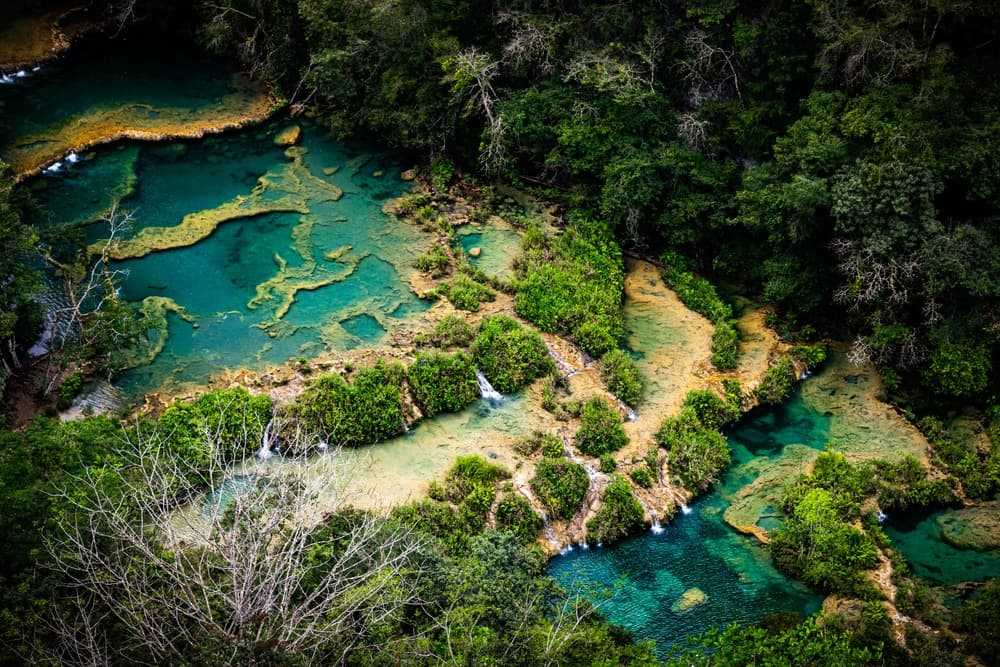
A swim in the lagoons of "Semuc Champey" is a remarkable experience. The underground galleries of "Cuevas de Lanquín" are fascinating. And the various towns throughout the region offer immersion into Mayan Indigenous culture.
History
The Kekchí Mayas had established themselves in what is now the Las Verapaces region long before Spanish conquest. They had built numerous villages along the great Río Cahabón river and traded in cacao, vanilla, and quetzal feathers with the Manche Ch'ol tribes to the north.
Their territory took the name Tezulutlán, or "zone of war," upon the arrival of the Spanish in the 16th century. The region became a genuine battlefield between foreign invaders and Mayas determined to preserve their independence.
While war continued to rage, Dominican friar Bartolomé de Las Casas undertook an entirely different approach: non-violent "pacification." Along with fellow priests from his order and four Mayas converted to Christianity, he traversed Tezulutlán spreading the Gospel.
The friar's message and gifts resonated with the Mayas, particularly with a great Kekchí chief. The latter agreed to convert to Christianity, took the name Juan, and asked his vassals to follow the new faith. Bartolomé de Las Casas's mission proved a resounding success. Chief Don Juan even helped him convert the surrounding villages.
By around 1543, the Dominicans had established themselves in the region. The "zone of war" thus became the "zone of peace" or "Verapaces." Several towns were built by the priests, notably Cobán, Lanquín, and Salamá. They also established the Doctrinas, institutions coordinating the activities of the towns. During the colonial period, they taught the Holy Scriptures, Spanish, and commerce to the Kekchí.
In 1754, the Dominicans had to hand over the organization of their Doctrinas to the secular clergy. And in 1829, they were expelled from the country. The Kekchí, meanwhile, had settled in the towns the priests had constructed.
Las Verapaces captured the attention of authorities in the 1990s. During this period, several natural parks were established. The Kekchí still live in the region today.
Las Verapaces Today
Las Verapaces is located in central Guatemala, roughly a hundred kilometers north of the country's capital. The region is so vast it spans two departments on its own: Alta Verapaz to the north and Baja Verapaz to the south.
The entire territory is bordered by impressive mountain ranges and covered in thick tropical forest. Wild animals live in harmony with nature amid the jungle. Given such environmental riches, authorities have established several natural reserves within Las Verapaces.
Alta Verapaz
The Alta Verapaz department comprises the northern part of Las Verapaces. To explore its wonders, one must first head to Cobán, its capital city.
The Semuc Champey National Park is located just a few kilometers east of Cobán. Within this natural reserve, jungle trekking trails, underground galleries, and incredible natural pools of turquoise hue are simply marvelous.
The lagoon of Parque Nacional Laguna Lachua is equally incredible, even though swimming is prohibited. Located 150 kilometers north of Cobán, its beautiful overlook offers fantastic views across the entire region.
Further north, the natural parks of Cuevas de Candelaria, Cuevas del Rey Marcos, and Grutas de Lanquín showcase incredible caves whose stalagmites take on strange forms.
To discover local wildlife, nothing beats venturing into one of the department's natural reserves, such as the Biotopo del Quetzal Mario Dary Rivera or the Reserva de la Biosfera Sierra de las Minas. Sierra de las Minas features more challenging hiking trails, but the effort is truly worthwhile. It is home to Central America's highest waterfall, Chilascó, where water plunges 130 meters down.
Baja Verapaz
The Baja Verapaz department lies in the southern part of the Las Verapaces region. Its charming capital, the city of Salamá, boasts several attractions worth a visit, including its Iglesia Colonial San Mateo, its Templo del Calvario, and its Cerro de la Cruz.
The flagship attraction of this part of Las Verapaces is undoubtedly the Corredor Biológico del Bosque Nuboso. This immense natural reserve harbors an impressive variety of plants such as orchids, pines, oaks, and eucalyptus. Part of the park, the Biotopo del Quetzal, is dedicated to the country's emblem, the Quetzal bird. Along its hiking trails, one may encounter monkeys, salamanders, or some friendly rodents.
In Baja Verapaz, do not miss the remarkable Salto de Chilasco waterfall. And a quick visit to the beautiful Rapiche museum or the lovely Rabinal church offers deeper insight into Indigenous life.
Climate
Las Verapaces enjoys a subtropical climate where temperatures range between 10°C, 25°C, and even 32°C depending on which parts of the region you visit. The rainy season extends from May through January, with a slight dip in precipitation at year's end and beginning. The dry season runs from February through late May. Even during this time of year, a certain humidity persists within the forest.
Getting There
By Air
Domestic flights serve the cities of Cobán and Salamá. Thus, you can easily reach one of these cities from Guatemala's capital.
By Road
You can also reach Cobán or Salamá by taking a bus from the bus stations in Antigua, Ciudad de Guatemala, or Santa Elena if you're in the northern part of the country.
Regional buses and pickup trucks allow you to move freely throughout the region and travel from one town to another.
A few tuk-tuks typically ply the streets of these municipalities. You can thus easily visit urban attractions aboard these three-wheeled vehicles.