Antigua and Volcanoes
Former colonial capital at 1,530 meters, surrounded by three volcanoes including active Fuego, base for Acatenango climbing and natural gateway to Guatemala.
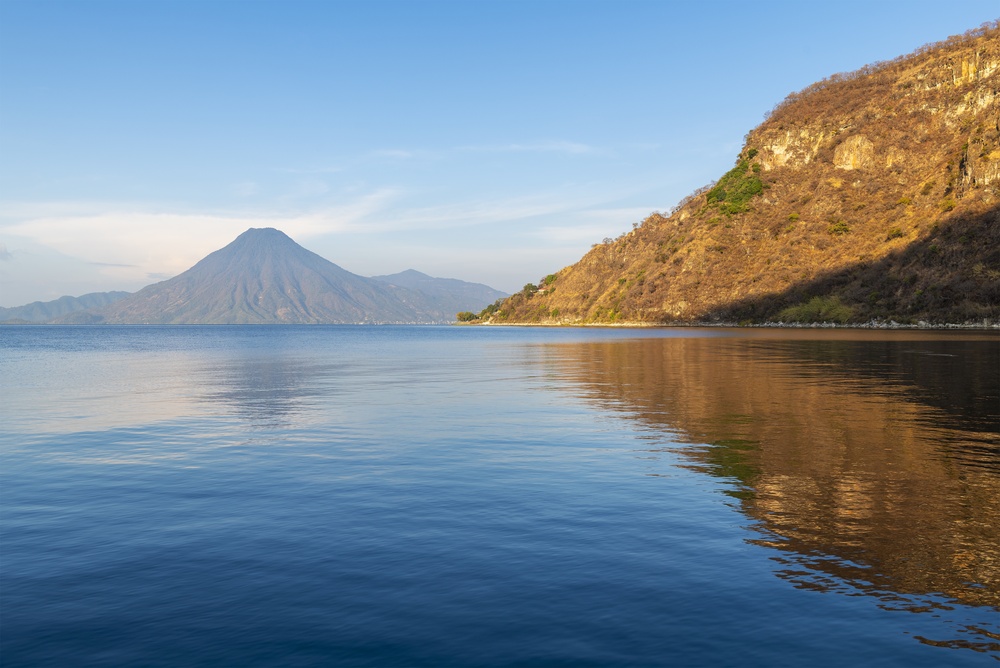
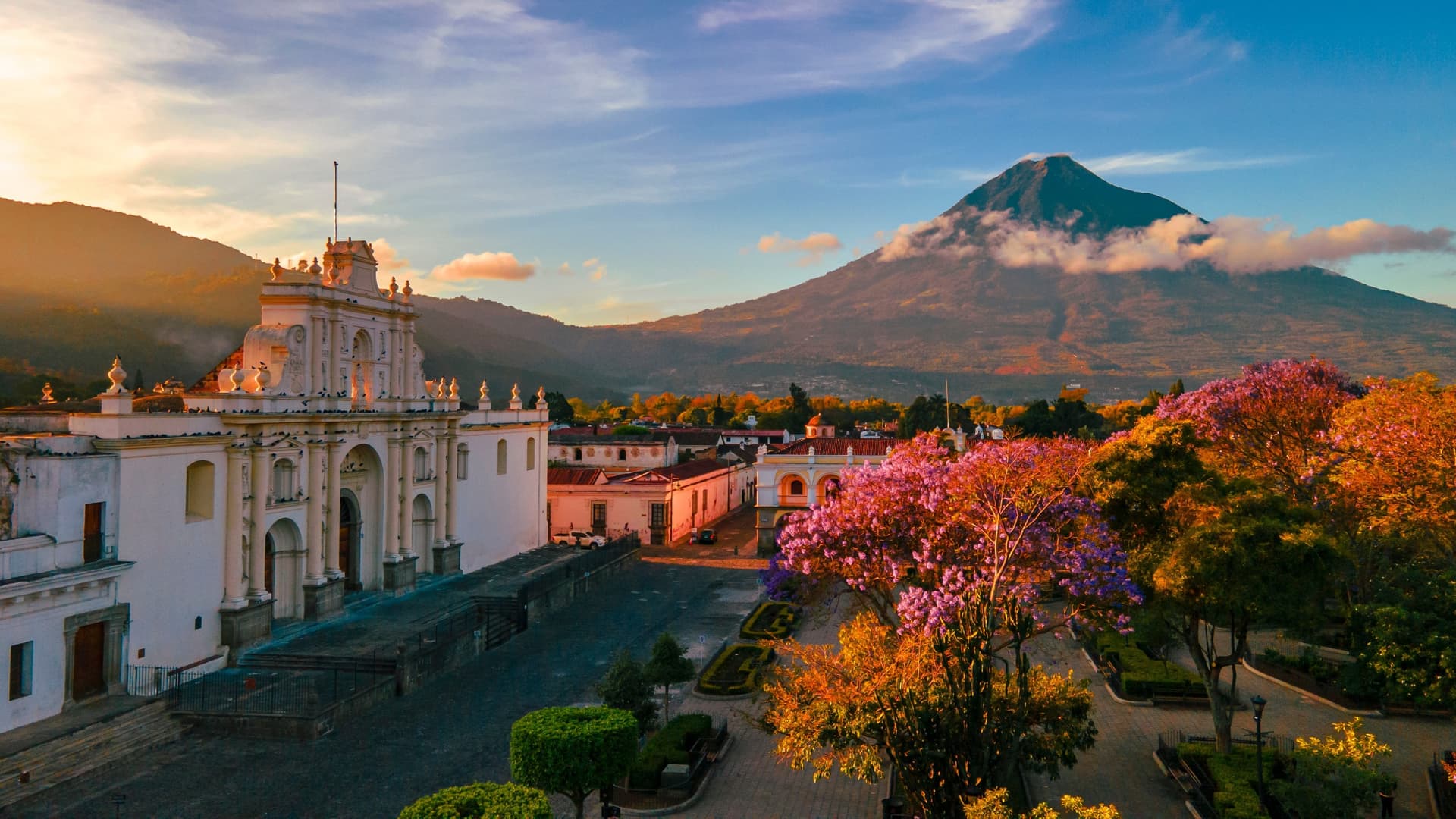
Antigua sits in a valley basin at 1,530 meters altitude in the Panchoy valley, framed by three volcanoes that structure the entire horizon: Agua to the south (3,760 m), Fuego to the southwest (3,763 m, in near-permanent activity), and Acatenango (3,976 m). Founded in 1543 as Santiago de los Caballeros, the city served as the capital of the General Captaincy of Guatemala for two centuries, a territory spanning Central America from Chiapas to Costa Rica. The Santa Marta earthquake of 1773 ended this chapter: the capital relocated 45 kilometers east to present-day Guatemala City. Antigua remained frozen in time, and this abandonment preserved its colonial grid, recognized by UNESCO in 1979.
The center is best explored on foot. From Plaza Mayor, bordered by Santiago Cathedral and the Palacio de los Capitanes, the main religious complexes are reached within fifteen minutes: the Santa Catalina arch on 5a Avenida Norte, the Convent of the Capuchins with its circular tower of nun cells, the ruins of San Francisco where Friar Pedro de Betancourt rests, and the former Jesuit college now a cultural center. Many of these buildings remain partially collapsed, consequences of the earthquakes of 1717, 1773, and 1976; they are visited as-is, without museum reconstruction, giving the city its particular character as an interrupted capital.
Antigua is also the heart of Guatemala's specialty coffee production. The surrounding volcanic slopes, between 1,500 and 1,700 meters, produce washed Arabicas with pronounced acidity, exported since the 19th century. Estates in the region, such as Filadelfia in Jocotenango or Azotea in San Felipe, can be visited in a half-day. In town, about a dozen roasters work directly with producers: lots from Huehuetenango, San Marcos, and the valley itself are available for tasting. Dining-wise, local cuisine combines pepián (meat stew with pumpkin seeds and sesame), kak'ik (turkey soup from the Verapaces), and daily plates served in the market's comedores, two blocks west of the central park.
Our team organizes the two-day Acatenango ascent from Antigua. The start is from the village of La Soledad at 2,400 meters, five hours of climbing through four vegetation zones: corn fields, cloud forest, highland forest, then volcanic scrub. The bivouac is set up around 3,600 meters, facing the Fuego cone situated 3 kilometers away as the crow flies. Strombolian eruptions occur every twenty to forty minutes, particularly visible after nightfall. For experienced hikers, a nocturnal extension to the Fuego ridge (six hours round-trip from camp) remains possible depending on volcanic activity, subject to your guide's assessment from INSIVUMEH.
Antigua also attracts long-term travelers for its Spanish language schools. More than seventy institutions offer individual lessons at 8 to 10 dollars per hour, often combined with host family accommodation. An intensive week of twenty hours enables learners to reach a usable level for the rest of their Guatemala or Central America journey, and it's an arrangement we regularly recommend early in stays.
The indigenous villages surrounding the city merit a day of their own. San Antonio Aguas Calientes for Kaqchikel weaving on backstrap looms, Santa María de Jesús on Agua's flanks for Monday and Thursday markets, San Juan del Obispo for artisanal chocolate workshops. Holy Week, from Palm Sunday to Easter Sunday, transforms the city: colored sawdust carpets rolled out through the streets, processions of thousands of bearers in purple tunics, constant incense. It's the busiest period of the year—book accommodation ten months ahead.
To Discover
Two-day Acatenango ascent. Five hours of climbing from La Soledad to the 3,600-meter bivouac, facing the nightly eruptions of Fuego three kilometers away. Sunrise over the Sierra Madre volcanic chain.
Colonial heart frozen since 1773. Grid of paved streets with Santiago Cathedral, Santa Catalina arch, and the Convent of the Capuchins. Ruins from successive earthquakes are visited as-is, without reconstruction.
Coffee estates on volcanic slopes. Plantations in Jocotenango or San Felipe between 1,500 and 1,700 meters, followed by comparative tastings at downtown roasters working in direct partnership with producers.
Antigua's Holy Week. From Palm Sunday to Easter, colored sawdust carpets laid across streets and processions of thousands of bearers in purple tunics. Reserve accommodation ten months in advance.
Surrounding Kaqchikel villages. Backstrap loom weaving in San Antonio Aguas Calientes, peasant market in Santa María de Jesús on Agua's flank, chocolate workshops in San Juan del Obispo.
When to Visit
The dry season runs from November to April, with clear days around 22 to 24°C and cool nights dropping to 10-12°C. December and January are the coolest months; February and March the driest and most stable for Acatenango climbing. The rainy season, May to October, brings concentrated afternoon downpours (200 to 250 mm monthly in June and September), though mornings often remain passable. Rain clears dust and makes landscapes greener, but reduces volcano visibility.
Two periods warrant particular planning. Holy Week, moving between late March and mid-April, saturates the city: prices double and accommodations fill eight to ten months ahead. Peak visual eruption activity of Fuego is unpredictable, but activity remains sufficient year-round to justify the ascent. Conversely, September and October sometimes see trails closed after heavy rain.
Practical Tips
Antigua is comfortably covered in two to three days, plus two for Acatenango and a day for Kaqchikel villages, totaling five to six days overall. Guatemala City's La Aurora International Airport lies 45 kilometers away, an hour's drive outside rush hours, making it the most logical arrival and departure point for any country visit. Most of our itineraries begin here: it's a gentle entry point at moderate altitude, allowing recovery from jet lag before continuing to the Mayan Highlands (Atitlán, Chichicastenango) three hours west by road, or to the Verapaces and Semuc Champey to the north. A domestic flight from Guatemala City then connects to Flores for Tikal and the Petén in one hour.
Antigua offers the country's highest comfort level: charming hotels in former convents, colonial guesthouses, author-driven restaurants. The city suits all profiles, from families with children (walking routes, short distances) to contemplative travelers (cafés, patios, museums), including hikers using it as a base before volcanic adventures. Our team based in the capital arranges transfers and on-site support; for Acatenango, we work with certified mountain guides equipped with cold-weather gear, essential for bivouacking.