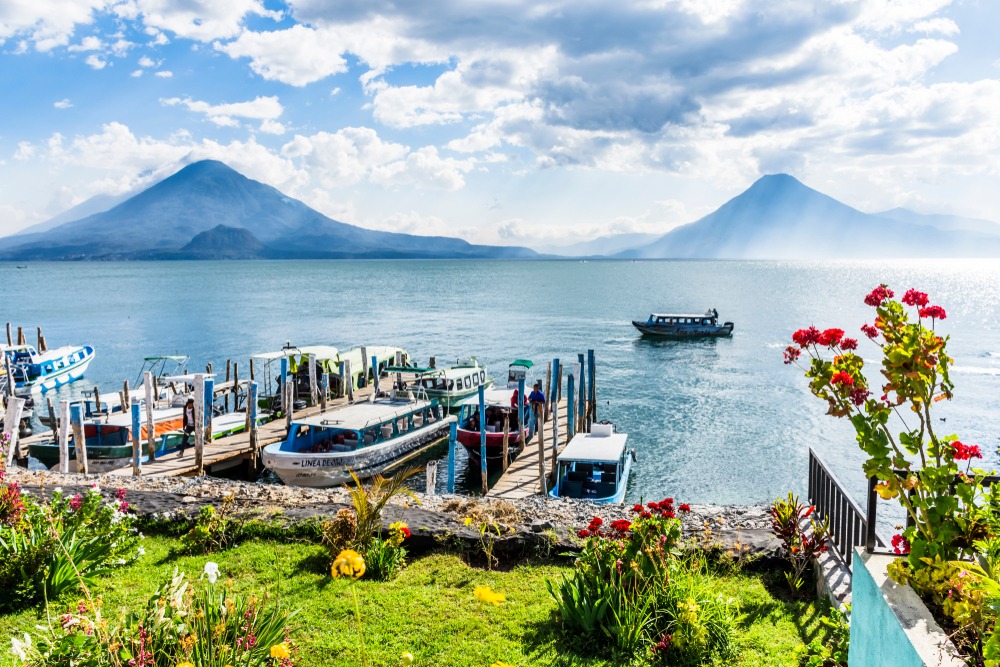
Volcán San Pedro
Volcán San Pedro rises to 3,020 meters above Lake Atitlán. A 4 to 6-hour hike with a mandatory guide, passing through pine forest and cloud forest, rewards you with unique panoramic views of the lake and Maya villages.
Volcán San Pedro dominates the southwestern shore of Lake Atitlán, facing the Maya villages that line its banks. Rising to approximately 3,020 meters, it offers one of the most complete panoramas of the lake and its neighboring volcanoes. The ascent, accessible to hikers in good physical condition, passes through several vegetation zones before reaching a summit often shrouded in clouds. It is an extinct volcano, classified as a private nature reserve.
Practical Information at a Glance
- Access: departure from San Pedro La Laguna, reachable by lancha (shared boat) from Panajachel or Santiago Atitlán
- Entrance fee: payable — nature reserve entry fee collected at the departure post
- Guide mandatory: a local guide is required to access the trail; several cooperatives offer this service in the village
- Recommended duration: allow 4 to 6 hours round trip depending on your pace
- Recommended departure: early morning to avoid clouds that cover the summit by late morning
- Equipment: hiking boots, sufficient water, warm clothing for the summit
What to See
The trail first passes through Maya agricultural plots, then a forest of pines and oaks, before reaching denser and more humid vegetation toward the summit. In clear weather, the view encompasses the entire Lake Atitlán, the Atitlán and Tolimán volcanoes to the southeast, and sometimes the Pacific plains in the distance. Local wildlife includes several bird species, with quetzals reported in the area.
History and Context
Volcán San Pedro is an extinct stratovolcano, one of three volcanoes that frame Lake Atitlán — itself formed by a volcanic caldera. Tz'utujil Maya communities have inhabited its slopes for centuries. The village of San Pedro La Laguna, at its base, is today a departure point for hikers and an active community center.
Highlights of the Visit
The View Over Lake Atitlán
In clear weather, the summit reveals a unique perspective over the lake and its twelve riverside villages. The golden hour of morning, before clouds arrive, offers the best viewing conditions.
The Cloud Forest
In the upper section of the trail, vegetation transforms into humid forest. Mosses, tree ferns, and orchids carpet the trees. The atmosphere here is radically different from the lower slopes.
The Village of San Pedro La Laguna
Before or after the climb, the village deserves a stop. Local market, weaving workshops, and cafés run by settled travelers create a distinctive atmosphere, blending Maya tradition with backpacker culture.
Photography Tips
Leave before 7 a.m. to maximize the chances of a clear summit. The best views of the lake are obtained in the final hour before the summit. During the dry season (November to April), conditions are considerably more favorable. Avoid the rainy season if panoramic views are your priority.
Location and Access
The volcano stands directly above San Pedro La Laguna, on the southwestern shore of Lake Atitlán. From Panajachel, shared lanchas regularly serve San Pedro. The trail begins at the village; local guide cooperatives are present at the trailhead. Vehicle access from the main road is possible to the village.
Nearby Attractions
- Lake Atitlán — the volcanic lake surrounding the volcano, one of Central America's most beautiful.
- Panajachel — the lake's main tourist hub and departure point for lanchas to San Pedro.
- Santiago Atitlán — Tz'utujil Maya village known for its market and the worship of Maximón.
- Volcán Atitlán — a taller and more demanding neighbor, visible from San Pedro's summit.
- San Marcos La Laguna — a quiet village renowned for its meditation centers and lakeside trails.
Frequently asked questions
Yes, a local guide is mandatory to access the trail. Guide cooperatives are present at San Pedro La Laguna at the trailhead.
The dry season, from November to April, offers the best conditions. During the rainy season, the summit is often covered in clouds by mid-morning.
Plan for 4 to 6 hours round trip depending on your pace and fitness level. The elevation gain is significant.
Shared lanchas connect Panajachel to San Pedro La Laguna several times daily. The crossing takes approximately 45 minutes to 1 hour depending on stops.
Volcán San Pedro is an extinct volcano with no known volcanic activity. Risks are those of any high-altitude hike: changing weather, slippery terrain during the rainy season.
Yes. Lanchas allow you to reach Santiago Atitlán, San Marcos La Laguna, or Panajachel the same day after your descent.
Interested in this visit?
We can include it in your personalised itinerary.